E23: Why Bank Loans Became More Expensive (And Why It May Not Fall Quickly)

Imagine two people walk into two different banks to borrow the same amount of money. They have similar jobs, similar incomes, and want the same type of loan.
But one person is offered a loan at 18% interest, while the other is offered 24%. This is possible due to how those banks priced their loans.
Before April 2018, commercial banks in Ghana used what were called base rates or prime rates to determine lending rates. Each bank developed its own internal formula for setting this benchmark. This meant that two people with similar profiles could approach different banks and receive different interest rates because the starting point used by each bank was not the same.
To improve transparency and create a more consistent system, the Bank of Ghana, together with the Ghana Association of Banks (GAB), introduced the Ghana Reference Rate (GRR) in 2018.
Think of the GRR as a starting point or foundation for pricing loans.
Instead of every bank creating its own benchmark, the industry would now have one publicly available reference rate, published monthly, that banks could use when determining lending rates.
The first official Ghana Reference Rate was announced in April 2018 at 16.82%.
However, the GRR is not the exact interest rate you pay on a loan.
Your final loan interest rate is usually influenced by:
- The GRR (the industry benchmark)
- The bank’s operating costs
- The type of loan
- Your personal risk profile (your ability to repay)
- Other charges and margins added by the bank
So, two people can still receive different loan offers because their risk levels and loan conditions may be different.
But the GRR gives borrowers a clearer picture of the general direction of borrowing costs in the economy.
Now to understand the recent news about “the GRR rising to 10.59% in July 2026, ending months of decline, I want you to see the journey of this GRR through the picture below so that you can understand how it may affect you when you choose to borrow money from a bank.
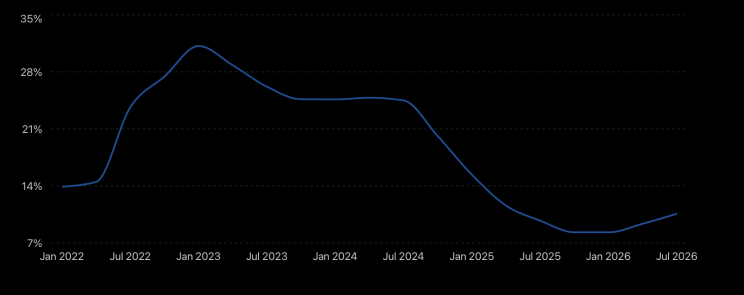
From around 14% in 2022, it climbed above 30% in 2023 as Ghana faced high inflation and economic challenges. Then, as economic conditions improved, the rate gradually declined. Now its 10.59%
But the recent increase reminds us of one important lesson:
When the economy changes, the cost of borrowing changes too.
Understanding these numbers helps you make better financial decisions — whether you are thinking about taking a loan, starting a business, or managing your personal finances.
The next time you hear that the Reference Rate has changed, don't just see it as an economic headline.
Ask yourself: "How could this affect the money I borrow, the business I want to start, or the financial decisions I make?"